
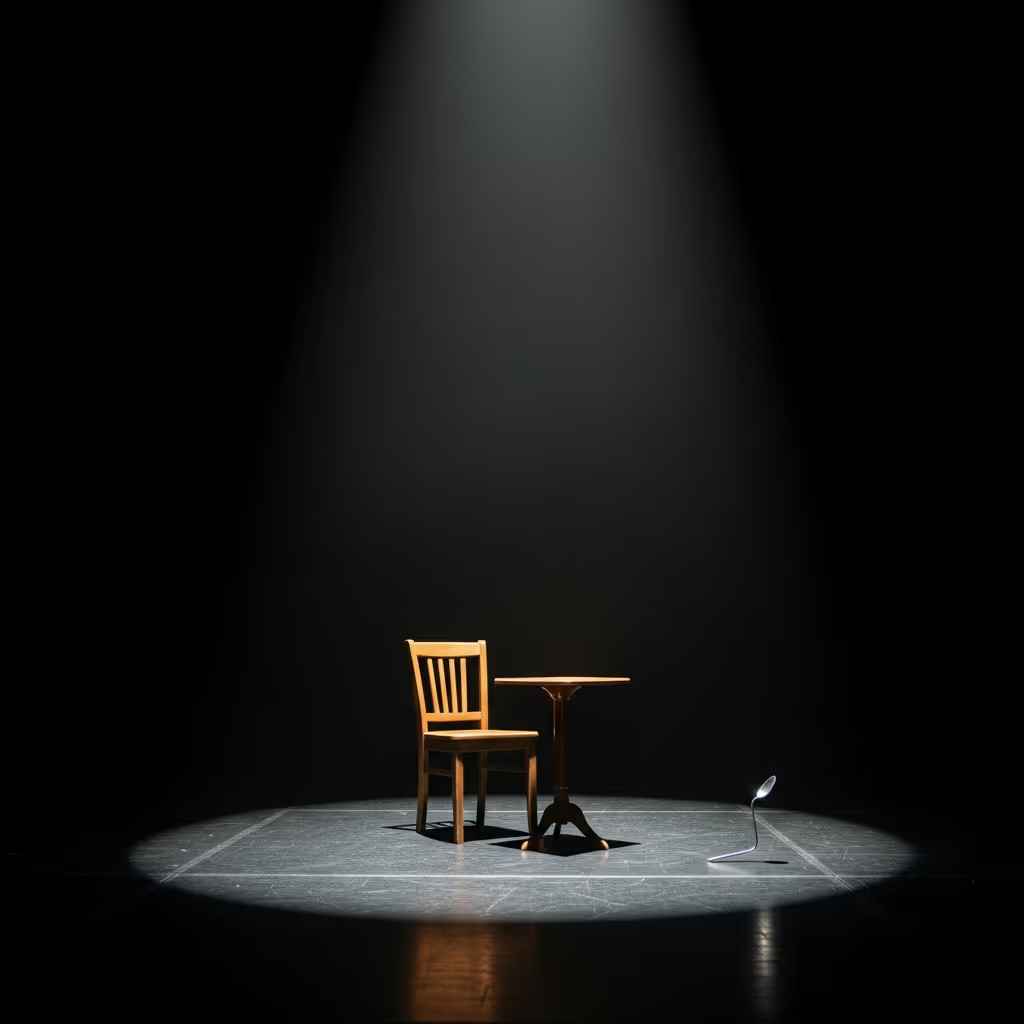
Consider the joke that was prepared. The setup was careful. The timing was deliberate. The punchline arrived exactly where it was supposed to, with the confidence of something that had been practiced. The room was quiet. Not the good kind of quiet — the other kind, where everyone is waiting for someone else to react first. And then, three sentences later, in a throwaway line that was not trying to do anything in particular, someone laughed. Then everyone laughed. The writer, if present, would have found this deeply instructive and mildly infuriating. The funniest moment in a story has a reliable habit of turning up where nobody put it, wearing the expression of someone who was simply passing through and had no intention of becoming the main event.
Comic writing is one of the few crafts where trying harder frequently produces worse results. The moments that land are rarely the moments that were constructed to land. They are the moments that arrived sideways — through a word choice that was almost but not quite right, a character reaction that was slightly too dignified for the situation, a detail that had no business being funny and was funny anyway. Understanding why the funniest moment in a story behaves this way does not make it easier to produce. But it does make it easier to recognize when it has arrived uninvited and should be kept.
Why the Prepared Joke Rarely Survives Contact With the Reader

There is a particular kind of comic scene that announces itself in advance. The setup is visible from some distance. The characters are arranged in the correct positions. Everything is in place for something funny to happen, and something funny duly happens, and the reader acknowledges it with the mild appreciation one extends to competent work.
This is not the funniest moment in a story. It is the most expected funny moment, which is an entirely different thing.
The prepared joke carries its own weight with it. The reader can feel the effort behind it, which creates a subtle resistance — not hostility, but awareness. And awareness, in comic writing, is the enemy of surprise. The laugh that arrives without warning bypasses awareness entirely. It is finished before the reader has time to evaluate whether it was supposed to be funny.
Children are particularly sensitive to this distinction. They do not laugh out of politeness. They laugh when something genuinely surprises them, which means the prepared joke, visible from three paragraphs away, will often produce less response than a single unexpected word in an otherwise ordinary sentence.
The Line That Was Not Trying

The funniest moment in a story tends to live in the details that were not assigned a comic purpose. A character's specific and unnecessary opinion about something irrelevant. A description that is one word more precise than it needed to be. A minor observation that arrives in the middle of something serious and refuses to be appropriately solemn about it.
These moments work because they carry no obligation. They are not standing where the laugh is supposed to be. They arrived because the writing was paying attention to something other than being funny, and in paying that attention, accidentally became exactly that.
There is a lesson here that is easier to state than to apply. The funniest moment in a story usually appears when the writer has stopped trying to write a funny story and started trying to write a true one. Truth, observed closely enough and described precisely enough, has a persistent tendency to become comic without being asked.
Writing a character who is genuinely funny without being foolish is, in practice, one of the more demanding things a story asks of its author — not because humor is difficult to construct, but because the best of it cannot be constructed at all. It has to be noticed.
What the Reader Remembers and Why

Ask someone to recall the funniest moment in a story they loved and they will almost never describe the scene that was built for laughs. They will describe something smaller. A word. A look. A moment where a character responded to an impossible situation with a completely inappropriate level of composure. Something that was, on the face of it, nothing very much.
This is the paradox at the center of comic writing. The moments that stay are the moments that did not insist on staying. They arrived quietly, made no demands, and then refused to leave. The reader carries them for years without entirely understanding why, which is precisely the condition in which the best humor operates.
Educators and parents who read aloud to children notice this effect regularly. The child does not laugh at the climax of the comic scene. They laugh at the sentence before it, or the sentence after, when the dust has settled and one small detail remains standing in a way that has no right to be funny and is anyway. Those are the moments worth finding. They cannot be placed. They can only be earned — slowly, honestly, by a story that was paying attention to the right things for long enough that something true slipped through.
The funniest moment in a story does not know it is the funniest moment. That is the whole secret of it. It arrived because the writing was honest, the detail was precise, and nobody was standing over it with instructions. It will not be found by looking for it directly. It tends to appear only when the story has forgotten to be careful — when it is simply telling the truth about a character or a situation, and the truth turns out to be, against all expectation, quietly hilarious. The writers who understand this best are the ones who have learned to get out of the way. The ones whose books, long after the plot has faded, leave a single line behind that a reader will find themselves repeating, at entirely the wrong moment, for the rest of their life.
Readers who find this idea useful may enjoy this post about Why funny characters in stories are the ones readers never forget — which explores the other side of the same question from the character's point of view rather than the writer's.